Dr. Dimple Doshi (MBBS, MD, DGO)
Lady Gynecologist & Laparoscopic Surgeon
27+ years’ experience
20,000+ surgeries completed
Endometriosis is usually a long-term condition, not an emergency — but some symptoms need prompt medical review.
Seek prompt or urgent care if you have:
If these occur, visit Vardaan Hospital or your nearest emergency room.
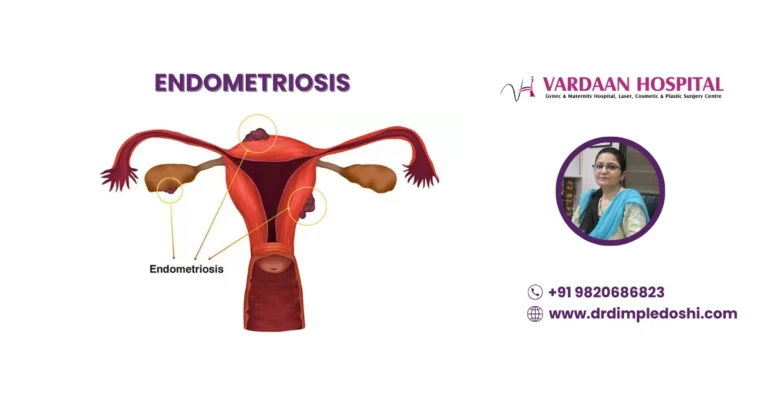
Endometriosis is a condition where tissue similar to the uterine lining grows outside the uterus, causing pain, inflammation and sometimes infertility.
Endometriosis (in everyday Hindi, women often describe it as severe maasik dard — period pain that isn’t normal) affects roughly 1 in 10 women of reproductive age. According to the World Health Organization (WHO), endometriosis affects about 10% — some 190 million — reproductive-age women worldwide.
Pain that disrupts your quality of life is not “just part of periods.” Early evaluation helps.
Endometriosis commonly causes painful periods, chronic pelvic pain, pain during intercourse, and difficulty conceiving — though some women have few symptoms.
Common symptoms include:
Symptom severity does not always match how much disease is present, which is why testing matters when symptoms persist.
Endometriosis has no single proven cause; it is linked to retrograde menstruation, immune and hormonal factors, and a family history.
Contributing factors thought to play a role:
Because the exact cause isn’t fully understood, treatment focuses on controlling the disease and protecting fertility rather than a single “fix.”
Endometriosis is grouped into three main types — peritoneal, ovarian (chocolate cysts) and deep infiltrating — and staged I–IV for severity.
The three main types:
| System | What it describes |
|---|---|
| ASRM stages I–IV | Minimal → severe, based on lesion extent and adhesions |
| Enzian classification (2021) | Maps deep infiltrating disease and organ involvement |
Staging guides treatment but does not always match symptom severity — a woman with early-stage disease can have significant pain.
Chocolate cysts are ovarian endometriomas — benign cysts of old blood that form when endometriosis grows on the ovary, causing pain or infertility.
Key facts:
When do chocolate cysts need surgery? Surgery is considered for cysts larger than about 4–5 cm, persistent pain, fertility concerns, or when linked to deep endometriosis — usually a laparoscopic cystectomy that preserves healthy ovary. Smaller, milder cysts may be managed with medicines and monitoring.
Are chocolate cysts cancerous? Chocolate cysts are almost always benign (non-cancerous); malignant change is rare. With proper diagnosis, monitoring and timely treatment, they are managed as a benign condition — persistent or growing cysts are simply reviewed more closely.
Endometriosis is diagnosed through history and pelvic exam, ultrasound and MRI, with laparoscopy giving the definitive diagnosis.
Typical steps:
A key advantage of laparoscopy is that diagnosis and treatment can happen together, often while preserving fertility.
Endometriosis can lower fertility through pelvic inflammation, adhesions, tube damage and ovarian cysts, yet many women still conceive.
How it can affect fertility:
Can you conceive naturally with endometriosis? Many women with mild-to-moderate disease conceive naturally; the chance depends on age, disease severity, ovarian reserve and tube function. Options range from lifestyle measures and fertility-preserving laparoscopic surgery to assisted reproduction (IVF) for severe disease. Surgery may improve fertility in selected women, but results are not certain, and IVF success is discussed as an age- and diagnosis-dependent range. For a fertility work-up, see female infertility evaluation. Outcomes vary by individual.
Endometriosis treatment ranges from lifestyle measures and medicines to fertility-preserving laparoscopic surgery, chosen to fit your symptoms and goals.
Care usually moves from least to most invasive:
| Option | What it involves | Suited to |
|---|---|---|
| Lifestyle / watchful care | Anti-inflammatory diet, exercise, weight and stress management, monitoring | Mild symptoms; supportive alongside other care |
| Medical therapy | Hormonal treatment (pills, progestins, GnRH agonists) and pain relief | Symptom control when pregnancy isn’t being actively sought |
| Laparoscopic surgery | Excision of lesions, removal of chocolate cysts, adhesiolysis — fertility-preserving | Persistent pain, cysts, deep disease, or fertility concerns |
Treatment is always individualised, and painful periods themselves are also addressed as dysmenorrhea. The surgical approach is explained in the next sections.
Surgery for endometriosis is considered when pain, chocolate cysts over about 4–5 cm, deep disease or infertility persist despite medicines.
Surgery is usually considered after conservative care, for women with:
Conservative options — lifestyle and hormonal or pain medicines — are generally tried first; surgery is the next step when symptoms persist or fertility is affected.
Laparoscopic endometriosis surgery uses keyhole cuts and 3D vision to excise lesions, remove chocolate cysts and free adhesions.
What the procedure involves:
The approach aims to remove disease thoroughly while keeping healthy tissue intact. Laparoscopic surgery is widely recommended for endometriosis because it allows precise excision with smaller cuts and a quicker recovery than open surgery — though it isn’t suitable for every case, and your surgeon advises what’s safest.
Recovery after laparoscopic endometriosis surgery is usually quick — light activity in about 7–10 days and fuller healing over 6–8 weeks.
A general guide (individual recovery varies):
| Stage | What to expect |
|---|---|
| Days 1–2 | Short hospital stay, pain controlled, early walking encouraged |
| First week | Rest with gentle activity, wound care, mild cramping or spotting |
| 7–10 days | Many resume light daily activity; follow-up review |
| 6–8 weeks | Fuller healing; gradual return to exercise and heavier activity as cleared |
Follow the specific restrictions your surgeon gives you, particularly on lifting, exercise and intercourse. Feeling well externally does not always mean internal healing is complete.
Laparoscopic endometriosis/chocolate cyst surgery in Mumbai ranges roughly ₹50,000 to ₹2,00,000 by complexity and room; final cost after consultation.
Approximate ranges at Vardaan Hospital:
| Room category | Approximate package (₹) |
|---|---|
| Standard room | ~50,000 |
| Semi-special room | ~68,000 – 75,000 |
| Deluxe room | ~1,20,000 onwards |
| Overall range | 50,000 – 2,00,000, by complexity |
Cost depends on disease severity, cyst size and number, operating time, consumables, room category and any associated procedures. At Vardaan Hospital, eligible patients may access cashless and reimbursement assistance, subject to insurance approval. Cost is a range and is finalised after consultation; outcomes vary by individual.
Diet and lifestyle do not replace medical treatment, but a healthy weight, anti-inflammatory diet and activity can support symptom control.
Supportive measures many women find helpful:
These complement — not replace — medical or surgical treatment, and can be combined with any care plan.
See a gynecologist if period pain disrupts daily life, pelvic pain persists, intercourse is painful, or you have trouble conceiving.
Reasons to seek evaluation:
Early diagnosis and expert management can help protect fertility and quality of life, and reduce the chance of long-term complications.
🩺 Dr Dimple Doshi Note: “Pain that disrupts your quality of life is not normal — please seek evaluation early. Many women with endometriosis can still conceive successfully, and early diagnosis with proper planning plays a key role in improving fertility. Where surgery is needed, my focus is on careful, fertility-preserving excision.”
Dr. Dimple Doshi offers expert, fertility-preserving endometriosis care using advanced 3D laparoscopy at NABH-accredited Vardaan Hospital, Goregaon West, Mumbai.
Full credentials are viewable on the About page.
Ans. Endometriosis is a chronic condition, but symptoms can be effectively managed with the right treatment. Early diagnosis helps protect fertility and quality of life. Many women lead full, healthy lives with proper care.
Ans. Yes, it can affect fertility through inflammation, adhesions or damage to reproductive organs. But many women with mild-to-moderate disease conceive, especially with early diagnosis and treatment.
Ans. Surgery removes visible disease and can relieve pain and support fertility, but endometriosis can sometimes recur. Treatment is individualised, and ongoing follow-up helps manage the condition over time.
Ans. Laparoscopic surgery is a commonly performed, minimally invasive procedure with a good safety record in suitable candidates, though every surgery carries some risk. Your surgeon explains the specifics for your case.
Ans. Chocolate cysts are almost always benign (non-cancerous). They can cause pain or affect fertility, so they are monitored and treated when needed — but malignant change is rare.
Ans. No. Smaller cysts with mild symptoms may be managed with medicines and monitoring. Surgery is considered for cysts over about 4–5 cm, persistent pain, fertility concerns, or deep endometriosis.
Ans. Many women resume light activity in about 7–10 days after uncomplicated laparoscopic surgery, with fuller recovery over 6–8 weeks. Your surgeon gives personalised clearance based on your job and recovery.
Ans. In selected cases, laparoscopic removal of lesions and chocolate cysts may improve fertility. Results are not certain and depend on age, severity and other factors, so treatment is personalised.
Book an Endometriosis Consultation with Dr. Dimple Doshi
If painful periods, pelvic pain or trouble conceiving sound familiar, a detailed consultation and scan can clarify what’s going on and which treatment — lifestyle, medicines or fertility-preserving surgery — suits you.