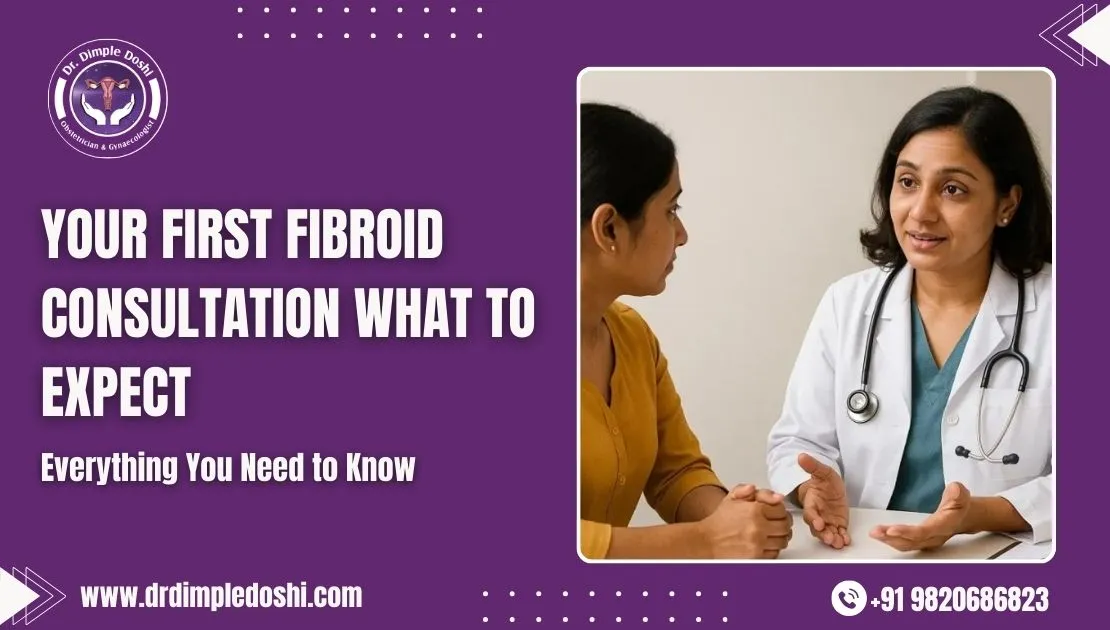
Walking into your first fibroid consultation can feel heavy—because you’re not just carrying reports, you’re carrying months (sometimes years) of bleeding, fatigue, pain, anxiety, and unanswered questions. The g………..ood news is: a well-structured first visit is not about rushing into surgery. It’s about understanding your fibroids properly and creating a clear, step-by-step plan that fits your body and your life.
Tired of heavy, exhausting periods? Get expert treatment options from Dr. Dimple Doshi.
1) You’ll Be Asked the Right Questions (History That Actually Matters)
Expect your gynecologist to explore:
Your symptoms in detail
- How heavy is your bleeding? (clots, soaking pads, flooding, night staining)
- How long does bleeding last?
- Pain: period cramps, pelvic pain, backache, pain during sex
- Pressure symptoms: frequent urination, constipation, heaviness, bloating
- Fatigue, breathlessness, palpitations (often due to anemia)
Your reproductive goals
- Do you want pregnancy now or later?
- Have you had infertility, miscarriages, or pregnancy complications?
Your cycle and hormonal background
- Age, cycle regularity, perimenopausal symptoms
- Past hormonal treatments tried (including response and side effects)
Medical and surgical history
- Prior cesarean sections or pelvic surgeries
- Thyroid issues, diabetes, hypertension
- Any history of clots, migraines, or liver problems (important for medication choices)
2) You’ll Get a Focused Examination (Not Just “Routine”)
A proper exam helps assess:
- Uterine size (bulky, irregular contour)
- Tenderness (to differentiate co-existing issues)
- Fibroid-related pelvic mass effect
This is also where your doctor decides whether imaging needs upgrading (e.g., basic scan vs mapping scan).
3) Your Reports Will Be Reviewed Like a Map, Not Like a Summary
Most patients come with an ultrasound. In the first consult, your gynecologist will look beyond “fibroid present” and focus on:
Fibroid mapping (the key points)
- Number of fibroids
- Size of each fibroid
- Exact location (submucosal / intramural / subserosal / cervical)
- Whether the fibroid is distorting the uterine cavity
- Effect on endometrium, ovaries, and surrounding organs
Why this matters:
Fibroid treatment depends more on location and cavity involvement than just size.
4) You May Need One or More Tests (To Plan Safely)
Your doctor may advise:
Blood tests
- CBC / Hemoglobin (to check anemia)
- Ferritin (iron stores—often overlooked)
- TSH (thyroid can worsen bleeding)
- If cycles are irregular: additional hormonal tests as required
Imaging (depending on your case)
- Pelvic ultrasound (TVS/abdominal): basic evaluation
- Saline sonography (SIS): if cavity distortion is suspected (especially for submucosal fibroids)
- MRI pelvis: for complex/multiple fibroids or surgical planning (“fibroid mapping”)
Endometrial evaluation (only when indicated)
- If you are >40, have intermenstrual bleeding, or risk factors, an endometrial biopsy may be advised to rule out other causes of heavy bleeding.
5) You’ll Discuss Treatment Options—And Why One Fits You Better
In the first consult, you should expect a clear explanation of options like:
A) Medical treatment (symptom control)
Used when:
- Fibroids are small or moderate
- Bleeding is the main issue
- You need temporary control (e.g., travel, wedding, exams)
- You’re building hemoglobin before definitive treatment
Typical categories include:
- Tranexamic acid, NSAIDs
- Progesterone-based options
- GnRH agonists/antagonists (selected cases)
(Your exact medication plan depends on your bleeding pattern, anemia, age, and fertility goals.)
B) Minimally invasive procedures (uterus-preserving or definitive)
Depending on fibroid type and your goals:
- Hysteroscopic myomectomy (for cavity fibroids)
- Laparoscopic/3D laparoscopic myomectomy (uterus preserved)
- Laparoscopic hysterectomy (definitive, if family complete)
- Robotic options (for selected complex cases)
In my surgical practice, 3D laparoscopy with the Karl Storz Rubina 3D system allows high precision, especially when fibroids are multiple, deep, or need careful suturing during myomectomy.
6) You’ll Be Told What’s Urgent vs What Can Wait
A good first consult should clearly classify your situation:
When treatment should not be delayed
- Hemoglobin very low or symptomatic anemia
- Rapidly worsening bleeding
- Severe pressure symptoms (urinary issues/constipation)
- Infertility where fibroids affect the cavity
- Suspicious imaging features (rare, but important)
When a planned approach is safe
- Symptoms are mild
- Fibroids are stable
- You’re near menopause and bleeding is controlled
- You want time to decide after understanding options
7) You’ll Leave With a Plan (Not Just a Prescription)
A proper first fibroid consultation ends with:
- A clear diagnosis (type + location + severity)
- Your anemia plan (iron/oral/IV as needed)
- What tests you need next (if any)
- Whether you need medical control first or definitive treatment
- A realistic timeline, including follow-up
What You Should Bring to Your First Fibroid Consultation
To make your visit efficient, carry:
- Ultrasound/MRI reports and films (if available)
- Recent blood reports (CBC, iron, thyroid)
- A list of medicines you’ve already tried
- A short note: bleeding duration, clotting, pad counts, pain score
- Any pregnancy/fertility history records
Quick FAQs Patients Commonly Ask on Day 1
Q1. Do I definitely need surgery?
Ans. Not always. Many women start with medical control or observation—depending on symptoms and cavity involvement.
Q2. Will fibroids affect fertility?
Ans. Some do, especially those that distort the uterine cavity. Mapping helps decide this.
Q3. Can fibroids shrink with medicines?
Ans. Some medications can temporarily shrink fibroids or reduce bleeding, but long-term results vary.
Still have questions about heavy bleeding, periods, or anemia? Get clarity from Dr. Dimple Doshi’s.
Closing Note
Your first fibroid consultation is the moment your symptoms finally get translated into a proper plan—what’s happening, why it’s happening, and what we can do about it. You deserve clarity, options, and a treatment path that respects your comfort, fertility goals, and long-term health.