
Self-Examination of Breasts: A Simple Habit That Can Save Your Life
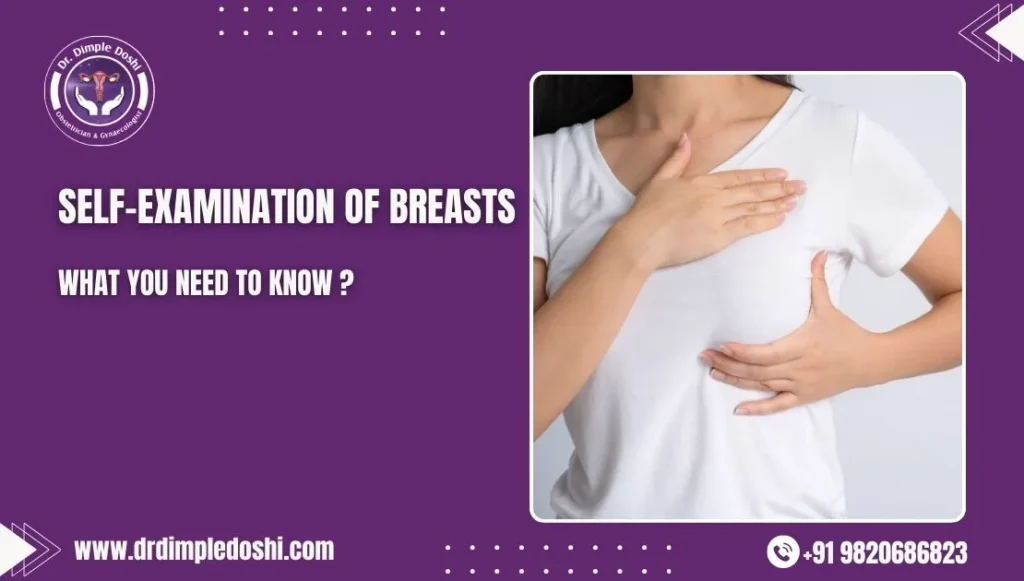
Introduction
Many women ignore small breast changes because they are painless or feel “normal.” Yet breast cancer is now the most common cancer in women worldwide. According to WHO (2020), 2.3 million women were diagnosed and 6.85 lakh deaths were reported in one year alone. Breast self-examination (BSE) is a simple monthly habit that helps you know your own body and detect changes early—when treatment and cure rates are excellent.
What is breast self-examination (BSE)?
Breast self-examination is a method where you examine your own breasts to detect lumps, swelling, or changes early.
A self-screening technique done by you at home
Involves:
Looking at your breasts
Feeling them with your fingers
Helps detect:
Lumps
Skin changes
Nipple discharge
Early-stage breast cancer has a very good prognosis and high cure rate
Dr. Dimple Doshi’s Tip:
In my clinical experience, women who do regular self-exams often detect changes much earlier than expected.
Why is self-examination of breasts important?
Regular breast self-examination helps detect breast cancer early, improving treatment success and survival rates.
Helps you understand what is normal for your breasts
Makes it easier to notice new or unusual changes
Early detection means:
Less extensive treatment
Better cosmetic outcomes
Higher chances of complete cure
Especially useful for younger women who may not yet need mammography
How do you visually examine your breasts?
Visual breast examination involves checking for skin changes, swelling, redness, or nipple changes in front of a mirror.
Stand in front of a mirror
Observe breasts in different positions:
Arms relaxed by your side
Arms raised behind your head
Hands pressed on your waist
Look for:
Dimpling or puckering of skin
Swelling or redness
Change in size or shape
Nipple inversion or discharge
How do you palpate (feel) your breasts correctly?
Breast palpation is done using finger pads to feel the entire breast tissue, including the area near the armpit.
Use the pads of your fingers, not fingertips
Apply gentle to moderate pressure
Cover the entire breast using any one method:
Vertical strip pattern: Move fingers up and down
Circular pattern: Small circles from nipple outward
Wedge pattern: From nipple towards the outer breast
You may also divide the breast into four quadrants
Always examine:
Whole breast
Axillary tail (breast tissue extending into the armpit)
Dr. Dimple Doshi’s Tip:
Choose one pattern and follow it every month—consistency matters more than the technique.
Should nipples also be examined?
Yes, nipples should be gently pressed to check for any abnormal discharge or changes.
Detailed Explanation:
Gently press each nipple
Look for discharge such as:
Blood
Pus
Clear fluid
Milk (if not breastfeeding)
Report any spontaneous or bloody discharge immediately
When is the best time to do breast self-examination?
The best time for breast self-examination is just after menstruation, when breasts are soft and less tender.
Ideal time: 5–7 days after periods
For women with irregular cycles:
Choose a fixed date every month
Can be done:
Standing
Lying down
During a shower (wet skin makes palpation easier)
Takes only 7–10 minutes
What are the risk factors for breast cancer?
Breast cancer risk increases due to genetics, lifestyle factors, hormonal exposure, and certain reproductive patterns.
Detailed Explanation:
Family history of breast cancer
Especially BRCA1 and BRCA2 mutations
Obesity
Lack of physical activity
Hormone replacement therapy
Early onset of menstruation
Late childbirth or no childbirth
Little or no breastfeeding
Past history of breast cancer
Alcohol consumption
Radiation exposure
Dr. Dimple Doshi’s Tip:
Even without risk factors, breast cancer can occur—self-examination is important for every woman.
FAQs – Common Questions Women Ask in OPD
Q1. Is breast self-examination enough to detect cancer?
Ans. It is a screening tool, not a replacement for clinical exams or mammography.
Q2. Does every breast lump mean cancer?
Ans. No. Many lumps are benign, but every lump should be evaluated.
Q3. At what age should I start BSE?
Ans. From early adulthood—ideally after 20 years of age.
Q4. Is breast pain a sign of cancer?
Ans. Usually no, but persistent pain should be checked.
Q5. Should pregnant or breastfeeding women do BSE?
Ans. Yes, though breasts change—any unusual lump should be examined.
Conclusion
Breast self-examination is a simple, free, and powerful habit that puts your health in your own hands. When breast cancer is detected early, outcomes are excellent and lives are saved.
In my practice at Vardaan Hospital, Goregaon West, Mumbai, I always encourage women to combine monthly self-examination with regular clinical check-ups. Knowing your body is not fear—it is self-care, awareness, and empowerment.
