Minimally Invasive Fibroid Treatments (Laparoscopic & Robotic)
Dr. Dimple Doshi (MBBS, MD, DGO)
Gynecologist & Laparoscopic Surgeon
27+ years’ experience
20,000+ surgeries completed
When fibroids start dictating your life—heavy bleeding, pelvic pressure, frequent urination, fatigue, or fertility concerns—you don’t always need a large cut and a long recovery. Minimally invasive fibroid surgery is designed to treat fibroids through small keyhole incisions, with less pain, less blood loss, shorter hospital stay, and faster return to normal routine—while still being a definitive treatment when medicines fail.
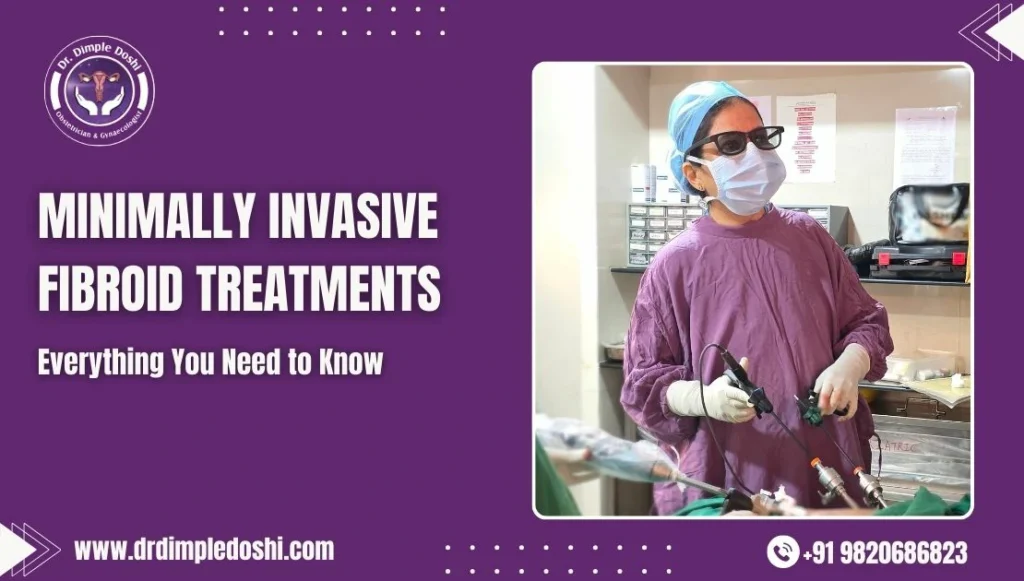
In my practice, minimally invasive fibroid surgery is most commonly done as laparoscopic (keyhole) surgery or robotic-assisted surgery, depending on fibroid size, number, location, and your future pregnancy plans.
Tired of heavy, exhausting periods? Get expert treatment options from Dr. Dimple Doshi.
What “Minimally Invasive” Means in Fibroid Treatment
- 3–4 tiny incisions on the abdomen (typically 5–10 mm)
- A camera that magnifies anatomy
- Fine instruments that remove fibroids or the uterus with precision
The two main minimally invasive approaches are:
- Laparoscopic fibroid surgery
- Robotic-assisted fibroid surgery
- Remove fibroids safely
- Preserve the uterus when needed (myomectomy)
- Reduce symptoms and improve quality of life
Who Is a Good Candidate for Minimally Invasive Fibroid Surgery?
You may benefit from laparoscopic or robotic treatment if you have:
- Heavy menstrual bleeding causing anemia
- Pelvic pain/pressure or bloating sensation
- Frequent urination or constipation due to pressure effect
- Infertility or recurrent pregnancy loss linked to fibroids
- Rapidly increasing fibroid size or persistent symptoms despite medicines
- Desire for uterus-preserving surgery (myomectomy) or a minimally invasive hysterectomy
Not every fibroid case is suitable for keyhole surgery, but many are—even when fibroids are multiple—provided proper planning and surgical expertise are in place.
Laparoscopic Fibroid Surgery
Robotic surgery is still minimally invasive (small incisions), but the instruments have:
- Greater articulation (wrist-like movements)
- Very stable precision
- Enhanced ergonomics for complex suturing
Robotic assistance can be helpful when:
- Fibroids are deep intramural
- Reconstruction needs meticulous suturing
- The case is technically complex (size, location, prior surgeries, adhesions)
Robotic myomectomy can offer excellent suturing precision, especially in demanding uterine repairs—important when future pregnancy is planned.
Robotic-Assisted Fibroid Surgery (Robotic Myomectomy / Robotic Hysterectomy)
3D laparoscopy improves depth perception and precision during fibroid removal and uterine repair.
When laparoscopic myomectomy is planned, Karl Storz Rubina 4K 3D helps with:
Clear fibroid enucleation and plane identification
Better bleeding control
Accurate multilayer uterine suturing
This supports:
Faster recovery
Smaller scars
Careful tissue handling, especially important when fertility is a concern
Laparoscopic vs Robotic for Fibroids: How the Choice Is Made
Both are effective. The decision depends on:
- Number of fibroids and total fibroid burden
- Largest fibroid size
- Location (front/back wall, fundus, near cervix, close to tubes)
- Cavity distortion and fertility goals
- Previous surgeries and adhesions
- Surgeon’s expertise and the technology available
The real “winner” is not the machine—it’s the planning + surgical skill + safe technique.
The Role of Advanced 3D Laparoscopy in Fibroid Surgery
In my laparoscopic work, I use 3D laparoscopy with the Karl Storz Rubina 3D system when appropriate. The advantage is depth perception and enhanced precision—especially useful for:
- Delicate dissection around bladder/ureter
- Accurate identification of planes
- Fine suturing during uterine reconstruction
- Better control in complex fibroid cases
For you, this can translate into more precise surgery, smoother recovery, and cosmetically better results—while maintaining safety.
What Recovery Typically Looks Like
While recovery varies, minimally invasive fibroid surgeries generally offer:
- Shorter hospital stay (often 24–48 hours, case-dependent)
- Earlier return to normal walking and light activity
- Reduced need for prolonged pain medication
- Faster return to work (commonly within 1–3 weeks depending on procedure)
Your recovery guidance will include:
- Activity progression
- Wound care
- Iron correction if anemia is present
- Follow-up and fertility guidance (if myomectomy was done)
Key Benefits of Minimally Invasive Fibroid Treatments
Compared to open surgery, laparoscopic/robotic approaches often provide:
- Smaller scars and better cosmetic outcome
- Less blood loss and lower transfusion rates (in suitable cases)
- Lower infection risk
- Shorter hospital stay
- Faster return to routine life
- Better overall comfort after surgery
When Minimally Invasive Surgery May Not Be Ideal
Sometimes open surgery may be safer if:
- There is extreme uterine enlargement with limited working space
- Complex anatomy or suspected malignancy needs a different approach
- Severe adhesions from multiple previous surgeries create high risk
- Any factor that compromises safety or surgical completeness
- When the patient is not fit for laparoscopic surgery like severe obesity; heart disease; or any other medical illness that contraindicates laparoscopic surgery
A good plan is always individualized, not “one method for all.”
FAQs: Minimally Invasive Fibroid Treatments (Laparoscopic & Robotic)
Q1. Can fibroids come back after laparoscopic or robotic myomectomy?
Ans. Yes, new fibroids can develop later because the uterus remains. The goal is symptom relief and fertility benefit when relevant.
Q2. Is robotic surgery always better than laparoscopy?
Ans. Not always. Both can be excellent. The best choice depends on your fibroid pattern and the surgeon’s experience.
Q3. Will I need a hysterectomy for fibroids?
Ans. Not necessarily. If you want uterus preservation, myomectomy is often possible. Hysterectomy is considered when family is complete and symptoms are severe or recurrent.
Q4. Can I get pregnant after minimally invasive myomectomy?
Ans. Many women do. What matters is type of fibroid, uterine cavity involvement, and quality of uterine repair.
Still have questions about heavy bleeding, periods, or anemia? Get clarity from Dr. Dimple Doshi’s.
Closing Note
If fibroids are draining your energy and confidence month after month, you deserve a solution that treats the problem without stealing weeks of your life in recovery. Minimally invasive fibroid treatments—laparoscopic and robotic—can offer safe, precise, and faster healing, especially when planned thoughtfully and performed with expertise and the right technology.
