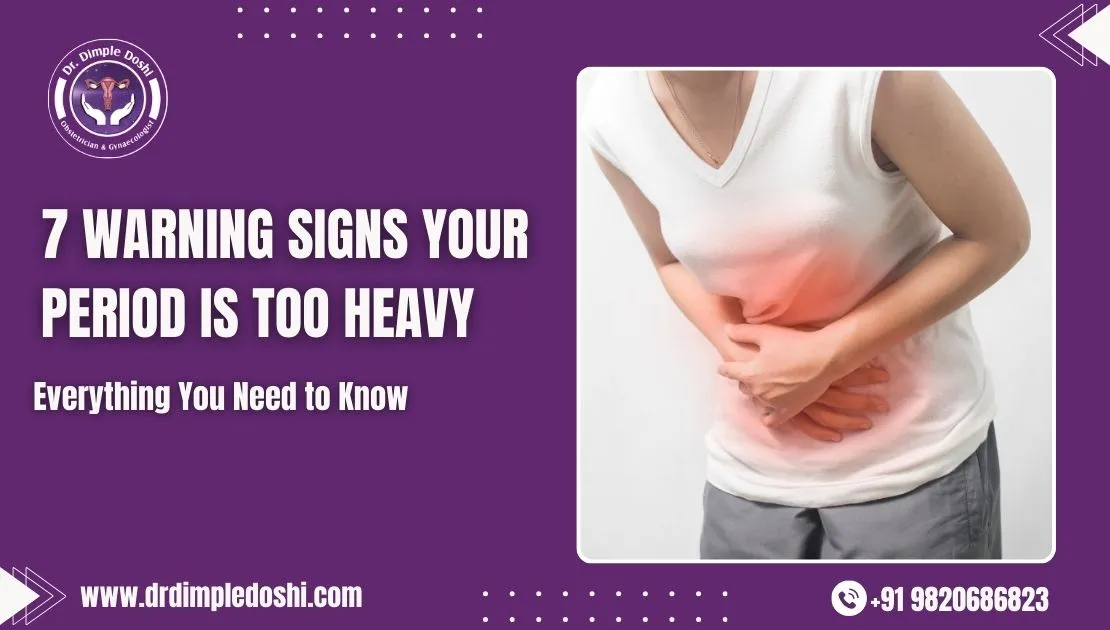
A heavy period isn’t just an inconvenience—it can quietly drain your iron, affect your energy, disrupt work, and sometimes signal conditions like fibroids, polyps, adenomyosis, thyroid imbalance, or a bleeding disorder. If you keep telling yourself, “This is normal for me,” it may be time to reassess.
Below are 7 clear warning signs your period may be too heavy (menorrhagia).
Tired of heavy, exhausting periods? Get expert treatment options from Dr. Dimple Doshi.
1) You Soak a Pad/Tampon Every Hour (or More Often)
If you’re soaking a fully loaded pad or tampon in one hour, especially for 2 or more hours, that’s a red flag.
Heavy bleeding should not force you to plan your day around washrooms.
Watch for: changing protection hourly, doubling protection, or fear of leaking.
2) You Need Double Protection to Feel Safe
If you routinely use two pads together, or tampon + pad, or you still leak despite that—your flow is likely heavier than normal.
This is especially concerning when it happens on multiple cycles and not just once in a while.
3) Your Bleeding Lasts More Than 7 Days
Most periods settle within 3–7 days. If you bleed beyond a week—especially with heavy days continuing—your uterus may be trying to tell you something.
Common causes: fibroids, adenomyosis, hormonal imbalance, endometrial hyperplasia, or polyps.
4) You Pass Large Clots (Bigger Than a ₹10 Coin)
Small clots can occur occasionally. But if you pass large clots repeatedly, or you pass clots with flooding bleeding, it often suggests excessive blood loss or pooling in the uterus before it exits.
Clue: clots that are thick, frequent, and associated with gushing.
5) You Wake Up at Night to Change Pads (or You Stain the Bed Often)
If your periods disturb sleep because you must change pads at night—or you commonly stain bedsheets—it’s not “just heavy,” it’s life-disrupting heavy.
Night-time flooding is one of the most practical, reliable warning signs.
6) You Feel Anemic: Fatigue, Breathlessness, Palpitations, Dizziness
Heavy bleeding can slowly cause iron deficiency and low hemoglobin, and many women don’t realize it until the body starts protesting.
Anemia symptoms to take seriously:
- tiredness that doesn’t match your routine
- breathlessness on climbing stairs
- palpitations
- light-headedness, headaches
- hair fall, brittle nails, cravings for ice/clay (pica)
7) You Avoid Social Plans or Work Because of Your Period
This is an underrated red flag. If your bleeding forces you to:
- skip outings,
- miss work,
- avoid travel,
- feel anxious about leakage,
- or stay home on “heavy days”
…your period is not just heavy—it’s affecting your quality of life, and it deserves medical attention.
What To Do If You Notice These Signs
If you have even 2–3 signs, please don’t ignore them—especially if you’re over 35, have diabetes/PCOS, or have a history of fibroids.
The basic evaluation usually includes:
- Pelvic ultrasound (to check fibroids, adenomyosis, polyps, ovarian cysts)
- CBC (hemoglobin) and serum ferritin (iron stores)
- Thyroid test (TSH) if indicated
- Sometimes Pap smear (if due) and endometrial evaluation depending on age, bleeding pattern, and ultrasound findings
How Heavy Periods Are Treated (In Simple Terms)
Treatment depends on the cause and your future fertility plans. Options can include:
- iron therapy (to rebuild stores)
- medicines to reduce bleeding and regulate cycles
- intrauterine options in selected cases
- hysteroscopy for polyp/submucous fibroid
- minimally invasive surgery when needed—often possible with 3D laparoscopy using the Karl Storz RUBINA 4K 3D system for better precision and faster recovery in suitable patients
When You Should Seek Urgent Care
Get help immediately if:
- you soak pads every hour with weakness/fainting
- you feel breathless, dizzy, or have chest pounding
- you have bleeding in pregnancy or after menopause
FAQs
Q1. Is it normal to have heavy bleeding for the first 1–2 days?
Ans. Some increase in flow on day 1–2 can be normal, but flooding, large clots, anemia symptoms, or >7 days bleeding is not.
Q2. Can fibroids cause heavy periods?
Ans. Yes—especially fibroids that distort the uterine cavity or increase uterine surface area.
Q3. What’s the biggest mistake women make?
Ans. Accepting heavy bleeding as “normal,” and treating only the symptom without checking the cause—until hemoglobin drops.
Still have questions about heavy bleeding, periods, or anemia? Get clarity from Dr. Dimple Doshi’s expert team.
Closing Note
Your period should not control your calendar, your confidence, or your hemoglobin. If you recognize these warning signs, an early evaluation can often prevent severe anemia and help you choose the simplest, safest treatment.