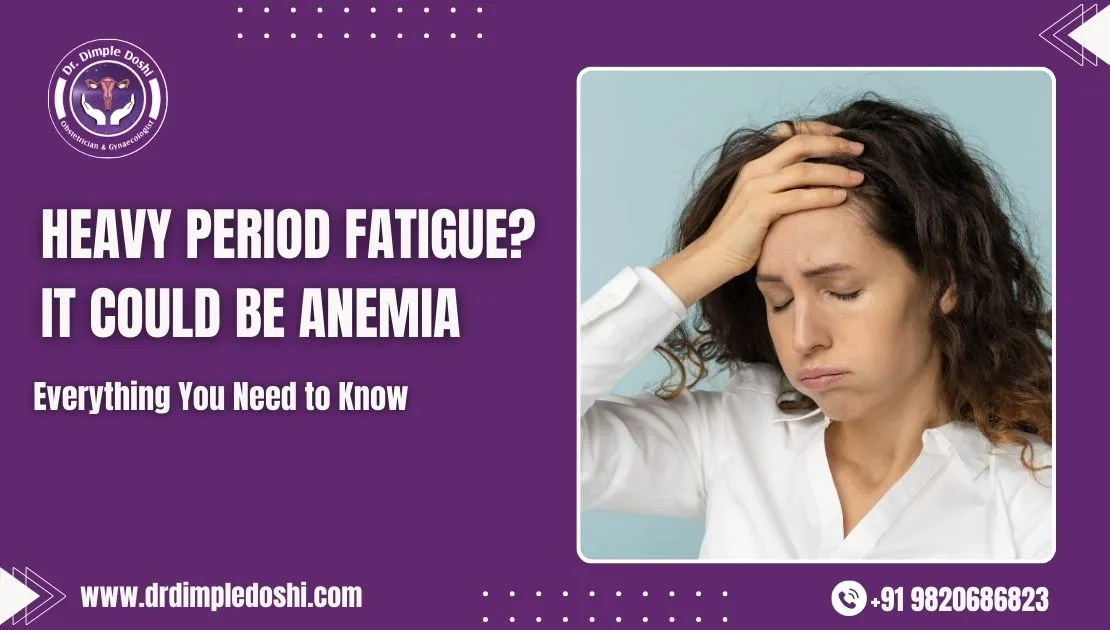
If you feel unusually tired, breathless, or “drained” during your periods (or even all month), don’t brush it off as stress. One of the most common hidden reasons is anemia caused by heavy menstrual bleeding.
In simple terms: when you lose too much blood every month, your body loses iron—and iron is essential for making hemoglobin, the oxygen-carrying part of your blood. Low oxygen delivery = low energy.
Tired of heavy, exhausting periods? Get expert treatment options from Dr. Dimple Doshi.
How Heavy Periods Lead to Anemia
Every period involves some blood loss. But when the flow is excessive, your body may not be able to replace iron fast enough.
The chain reaction looks like this:
Heavy bleeding → iron loss → iron stores fall (low ferritin) → hemoglobin drops → anemia → fatigue and weakness
Important: Many women develop iron deficiency first (low ferritin) even before hemoglobin becomes clearly low. So you can feel tired while your Hb looks “just borderline.”
Signs Your Fatigue Might Be Anemia (Not Just Busy Life)
Fatigue from anemia has a very particular feel—your body feels heavy and slow, even after rest.
Look for these symptoms:
- Constant tiredness or low stamina
- Breathlessness while climbing stairs
- Palpitations (fast heartbeat)
- Dizziness or feeling faint
- Headaches, brain fog, poor concentration
- Pale skin, dark circles that worsen
- Hair fall, brittle nails
- Craving ice, clay, or chalk (pica—classic iron deficiency sign)
- Forgetfulness; headache and confusion sometimes
If you’re experiencing fatigue mainly around periods, or worsening month by month, anemia becomes very likely.
Warning Signs Your Period Is “Too Heavy”
Your flow may be medically heavy if you have any of these:
- Soaking a pad/tampon every hour (especially for 2+ hours)
- Needing double protection (pad + tampon / two pads)
- Passing large clots repeatedly
- Bleeding more than 7 days
- Waking at night to change pads or staining the bed regularly
- Your routine, travel, or work gets disrupted due to bleeding
Common Causes Behind Heavy Periods (That Trigger Anemia)
Heavy bleeding is a symptom—not a final diagnosis. Common causes include:
- Fibroids (especially those affecting the cavity)
- Adenomyosis
- Endometrial polyps
- Hormonal imbalance / anovulatory cycles (PCOS, perimenopause)
- Thyroid issues
- Endometrial hyperplasia (especially in prolonged irregular cycles)
- Copper IUCD (in some women)
- Bleeding disorders (less common, but important—especially if heavy bleeding since teenage years)
What Tests Confirm Anemia Due to Heavy Periods?
The evaluation is straightforward and very helpful.
Basic tests:
- CBC (Complete Blood Count): checks hemoglobin and red cell indices
- Serum ferritin: your iron storage marker (very important)
- Sometimes serum iron / TIBC / transferrin saturation (if needed)
To find the cause of heavy bleeding:
- Pelvic ultrasound
- TSH (thyroid) if clinically indicated
- Endometrial evaluation depending on age, risk factors, and ultrasound findings
(especially if bleeding is irregular, prolonged, or you’re >35)
How It’s Treated: 2 Parallel Goals
Treatment works best when we do two things together:
Goal 1: Rebuild your iron and hemoglobin
Depending on severity:
- Oral iron (for mild to moderate deficiency)
- IV iron (if Hb is significantly low, absorption is poor, you need faster correction, or you can’t tolerate oral iron)
- Nutritional support: iron-rich foods + absorption tips (but food alone rarely corrects significant anemia quickly)
- Blood transfusion may be needed if hemoglobin is too low.
Goal 2: Reduce the bleeding at the source
Options depend on your diagnosis and fertility plans:
- Medicines to reduce menstrual blood loss
- Hormonal regulation when appropriate
- Hysteroscopy for polyps or submucous fibroids
- If fibroids/adenomyosis are significant: minimally invasive surgery may be advised
Many suitable cases can be managed with 3D laparoscopic surgery using the Karl Storz RUBINA 3D system, which allows precise surgery with faster recovery.
When Fatigue Becomes a Medical Red Flag
Seek urgent medical care if:
- You feel faint, extremely weak, or breathless at rest
- Your heart races or you have chest discomfort
- You are soaking pads hourly with giddiness
- Your Hb is very low (or suspected low)
Severe anemia is not just “weakness”—it can strain the heart and reduce your ability to function safely day to day.
FAQs
Q1. Can I be iron deficient even if my hemoglobin is ‘normal’?
Ans. Yes. Early iron deficiency often shows up as low ferritin before Hb drops.
Q2. Will iron tablets alone fix the problem?
Ans. Iron can rebuild blood, but if heavy bleeding continues, anemia often returns. The best plan treats both: iron deficiency + the bleeding cause.
Q3. How fast will I feel better after starting treatment?
Ans. Many women feel improvement in energy within a couple of weeks, but full replenishment—especially ferritin—takes longer. Consistency matters.
Still have questions about heavy bleeding, periods, or anemia? Get clarity from Dr. Dimple Doshi’s expert team.
Closing Note
If your periods leave you exhausted, it is not a “normal female thing” you must live with. Heavy bleeding is treatable—and anemia is reversible—once we identify the cause and correct iron loss properly.