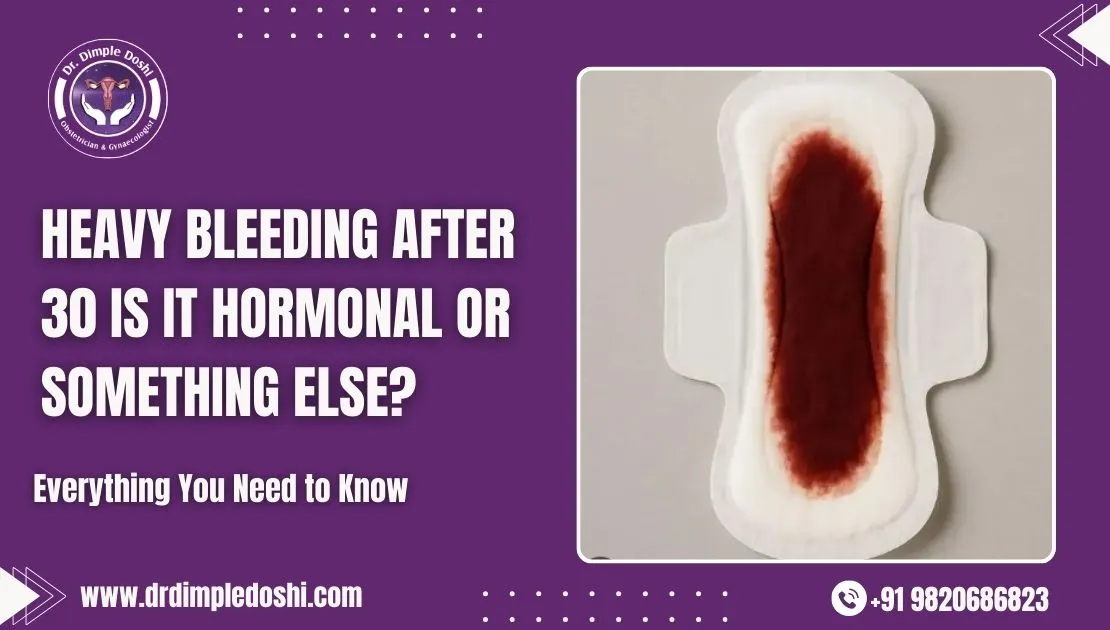
If your periods have suddenly become heavier after 30—flooding, clots, soaking pads quickly, or bleeding that interferes with work and life—it’s natural to wonder: “Is this a hormonal phase… or is something wrong?”
Here’s the reassuring truth: many cases are hormonal and treatable, but after 30, heavy bleeding also commonly has structural causes (like fibroids or polyps) that deserve a proper check. The good news is—once we identify the cause, we can usually control bleeding effectively, often without major surgery.
Tired of heavy, exhausting periods? Get expert treatment options from Dr. Dimple Doshi.
Quick clarity: What counts as “heavy bleeding”?
You may be having heavy menstrual bleeding if you:
- Soak a pad/tampon every 1–2 hours
- Pass large clots repeatedly
- Need double protection (pad + tampon)
- Wake up at night to change pads
- Bleed longer than 7 days
- Feel tired, dizzy, breathless—suggesting anemia
If you’re thinking, “This is me,” you’re not alone—and you’re not overreacting.
The two big buckets after 30
Heavy bleeding after 30 typically comes from either:
1) Hormonal / functional causes (common)
This means the uterus is structurally normal, but the cycle regulation is off.
Typical hormonal patterns:
- Anovulatory cycles (no egg release) → unpredictable, heavier bleeding
- Luteal phase issues → spotting before periods
- Perimenopause begins earlier than expected (late 30s/early 40s for some women)
- Thyroid imbalance (especially hypothyroidism)
- PCOS (irregular cycles + heavy bleeding episodes)
- Stress, weight changes, intense travel/sleep disruption affecting ovulation
Clue: Hormonal bleeding is often irregular, may come with PMS shifts, cycle length changes, acne/hair changes, mood swings, or weight fluctuation.
2) “Something else” (structural or medical) — very common after 30
After 30, we must actively rule out structural causes in the uterus.
Common non-hormonal causes:
- Fibroids (uterine leiomyomas): heavy bleeding, clots, pelvic heaviness, frequent urination
- Endometrial polyps: bleeding between periods, post-sex spotting, prolonged bleeding
- Adenomyosis: heavy bleeding + severe cramps + bulky tender uterus (often after childbirth)
- Endometriosis (sometimes): pain dominates, but bleeding can be heavier too
- Copper IUCD: can increase flow/cramps
- Infections / endometritis: irregular bleeding + discharge/pain in some cases
- Bleeding disorders (less common but important): easy bruising, gum bleeds, family history
- Precancer/cancer changes: uncommon, but must be excluded—especially with risk factors
Clue: Structural causes often give regular monthly periods but heavier and heavier flow over time, plus clots, pain, pressure symptoms, or intermenstrual spotting.
Red flags: Don’t “wait and watch” if you have these
Please treat these as urgent evaluation signals:
- Bleeding so heavy you feel faint/weak
- Bleeding after sex (post-coital bleeding)
- Bleeding between periods repeatedly
- Bleeding after a missed period with possible pregnancy
- New heavy bleeding after 40
- Persistent bleeding despite medicines
- Severe anemia symptoms (breathlessness, palpitations, extreme fatigue)
- Family history of uterine/colon cancers, or you have obesity/diabetes/PCOS with irregular cycles
Why heavy bleeding after 30 can’t be ignored
Because the uterus is not just “bleeding”—it’s signalling.
- Heavy bleeding commonly leads to iron deficiency anemia, hair fall, fatigue, low immunity
- Ongoing blood loss affects work, intimacy, mood, and confidence
- Structural causes like fibroids/polyps can grow silently
- In some women, unchecked hormonal imbalance can cause endometrial overgrowth (hyperplasia)
You deserve an answer—not just temporary relief.
What evaluation usually looks like in clinic
A focused, stepwise approach helps you avoid unnecessary tests.
1) Detailed history (this is often diagnostic)
- Cycle pattern, clot size, pain, intermenstrual spotting
- Pregnancy possibility
- Contraception (especially IUCD)
- Thyroid/PCOS symptoms
- Medications (blood thinners)
- Family history of bleeding disorders/cancers
2) Basic tests
Commonly:
- CBC + ferritin (for anemia and iron stores)
- TSH (thyroid)
- Pregnancy test when relevant
- Additional tests based on your story (e.g., prolactin, coagulation profile)
3) Ultrasound (the key first imaging)
A pelvic ultrasound helps assess:
- fibroids, adenomyosis features
- polyp suspicion
- endometrial thickness and pattern
- ovarian cysts/PCOS pattern
4) When hysteroscopy becomes important
If ultrasound suggests a polyp, submucous fibroid, or thick/irregular endometrium, a hysteroscopy (camera evaluation inside the uterus) is often the best next step—because it is both diagnostic and treatable.
Treatment: It depends on your cause, age, and fertility goals
There is no one-size-fits-all. The right treatment is the one that:
- stops heavy bleeding safely
- corrects anemia
- respects fertility plans
- prevents recurrence
If it’s hormonal (no structural lesion)
Options may include:
- Tranexamic acid (reduces bleeding during periods)
- NSAIDs (help pain + can reduce blood loss in some women)
- Progesterone therapy (cyclic or continuous—depending on pattern)
- Combined hormonal pills (if suitable)
- Levonorgestrel IUD (hormonal IUCD): one of the most effective long-term options for heavy bleeding in many women
Lifestyle support matters too (sleep, weight management, iron-rich diet), but it should support treatment—not replace diagnosis.
If it’s a polyp or submucous fibroid
Often best managed by hysteroscopic removal—targeted, uterus-preserving, and typically quick recovery.
If it’s fibroids, adenomyosis, or larger structural disease
Management depends on size, location, symptoms, and family completion:
- Medical bleeding control (when appropriate)
- Myomectomy (fibroid removal) if fertility desired
- Minimally invasive laparoscopic surgery when surgery is needed
When I operate, precision matters—especially around bleeding control and delicate planes. Using advanced 3D laparoscopy (like the Karl Storz Rubina 4K 3D system) can enhance depth perception and fine dissection, often helping with smoother surgery and recovery in suitable cases.
“So… is it hormonal or something else?”
Here’s a simple way to think:
- Irregular cycles + unpredictable heavy bleeding → often hormonal
- Regular cycles but progressively heavier + clots/pressure symptoms → often structural (fibroid/polyp/adenomyosis)
But the overlap is real—so the safest approach after 30 is, assume nothing, evaluate properly, treat specifically.
FAQs
Q1. Can stress alone cause heavy periods after 30?
Ans. Stress can disrupt ovulation and worsen bleeding patterns, but it should not be blamed until structural causes are ruled out.
Q2. Are clots always dangerous?
Ans. Small clots can occur in heavy flow, but repeated large clots usually indicate significant bleeding and often needs evaluation for fibroids/polyps/hormonal imbalance.
Q3. When is endometrial biopsy needed?
Ans. Usually if there are risk factors (age, obesity, diabetes, PCOS with prolonged irregular cycles), persistent bleeding, or ultrasound suggests abnormal endometrium.
Q4. Is hysterectomy always required for heavy bleeding?
Ans. No. Many women improve with medicines, hormonal IUCD, hysteroscopic procedures, or uterus-preserving surgery. Hysterectomy is considered when symptoms are severe, recurrent, and family is complete—or when medically indicated.
Still have questions about heavy bleeding, periods, or anemia? Get clarity from Dr. Dimple Doshi’s expert team.
A calm closing thought
Heavy bleeding after 30 is common—but it’s not something you should normalize and suffer through. With the right diagnosis, most women get excellent control, improved energy, corrected anemia, and a much better quality of life.
If you’re in or around Goregaon West, you can get evaluated with a focused plan—so you stop guessing and start healing.