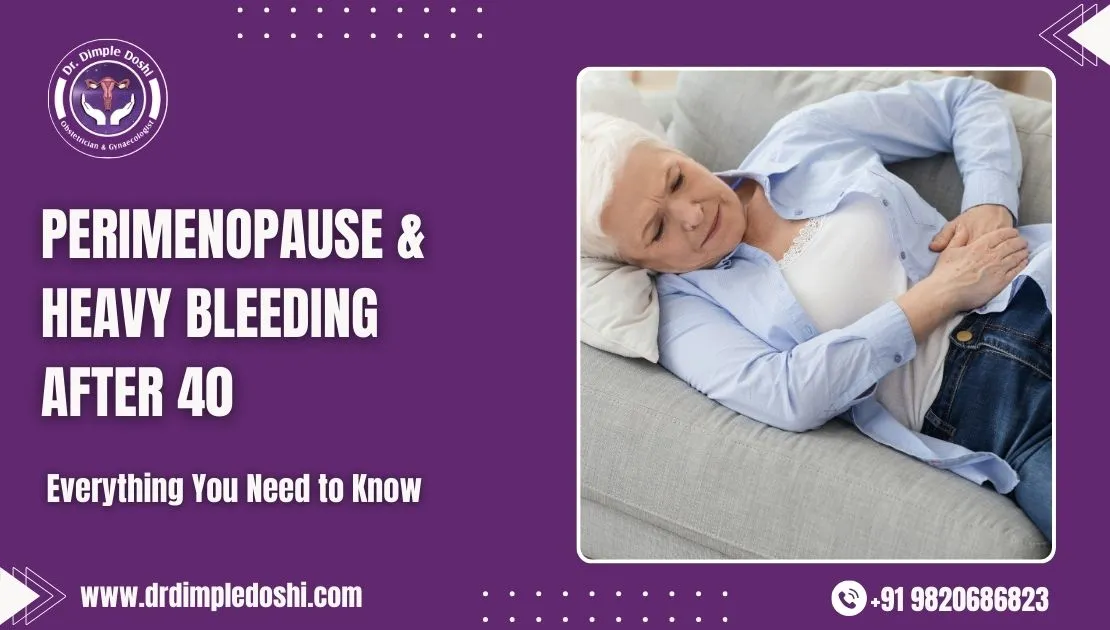
You’re 42. Your periods were predictable for years… and suddenly they’re flooding, lasting longer, coming too early, or showing up after a gap—sometimes with clots, cramps, and exhaustion that feels deeper than “just a heavy period.”
In your 40s, this is common—but it is not something you should ignore.
Heavy bleeding in perimenopause can be hormonal, but it can also be due to fibroids, polyps, adenomyosis, thyroid issues, clotting problems, or (rarely) endometrial changes that need urgent attention. The key is: don’t guess—evaluate.
Tired of heavy, exhausting periods? Get expert treatment options from Dr. Dimple Doshi.
What Exactly Is Perimenopause?
Perimenopause is the transition phase before menopause (the final period). It often starts in the early-to-mid 40s (sometimes late 30s) and can last several years.
In this phase, ovulation becomes irregular, progesterone often drops first, and estrogen can swing high and low. This hormonal “see-saw” commonly causes:
- Irregular cycles
- Heavy or prolonged bleeding
- Spotting between periods
- Clots
- PMS-like symptoms that feel worse than before
Why Heavy Bleeding Happens in Your 40s
1) Hormonal imbalance (anovulatory cycles)
If you don’t ovulate, you don’t form a stable corpus luteum → less progesterone → the endometrium keeps growing under estrogen → later it sheds heavily and unpredictably.
2) Structural causes (very common after 40)
These are “inside the uterus” causes that often coexist with perimenopause:
- Fibroids (uterine leiomyomas): heavy flow, clots, pressure, frequent urination
- Endometrial polyps: spotting, bleeding after sex, unpredictable bleeding
- Adenomyosis: heavy bleeding + intense cramps + bulky tender uterus
3) Endometrial hyperplasia (needs evaluation)
Especially in women with:
- obesity, PCOS history, diabetes/prediabetes
- prolonged irregular cycles
- family history of endometrial cancer
- long-term unopposed estrogen exposure
4) Medical causes
- Thyroid dysfunction
- Bleeding/clotting disorders (less common, but important)
- Medications (blood thinners, some hormonal therapies)
How Heavy Is “Too Heavy”?
Heavy bleeding is a red flag if you have any of these:
- Soaking one pad/tampon every hour for 2+ hours
- Passing large clots repeatedly
- Bleeding more than 7 days
- Needing double protection or waking at night to change pads
- Feeling dizzy, breathless, palpitations, extreme fatigue
- Any bleeding after sex
- Bleeding between periods or after a long gap
- Bleeding after menopause (even a single episode)
If you’re thinking: “This is not my normal,” trust that instinct.
What Your Gynecologist Will Check
Step 1: Clinical assessment
- Cycle pattern, clot history, pain, weight changes
- Pregnancy test (yes—even in the 40s if periods are irregular)
- Anemia symptoms and vitals
Step 2: Tests (most commonly needed)
- CBC (hemoglobin/ferritin) for anemia
- TSH (thyroid)
- Sometimes: sugar profile, coagulation tests (based on history)
Step 3: Ultrasound (timed properly)
- Transvaginal ultrasound (TVS) is key
Often best soon after bleeding stops / early cycle to assess endometrium and look for polyps/fibroids clearly.
Step 4: Endometrial evaluation when indicated
In many women 40+ with heavy/irregular bleeding, your doctor may advise:
- Endometrial biopsy (quick OPD procedure)
or - Hysteroscopy (camera evaluation) ± polyp removal
This is not to scare you—this is to rule out what we must not miss, and then treat confidently.
Treatment Options (Not One-Size-Fits-All)
Your treatment depends on:
- your ultrasound findings
- hemoglobin level
- severity of bleeding
- whether you want uterus preservation
- presence of fibroids/polyps/adenomyosis
- your overall health (thyroid, sugar, BP)
A) When bleeding is acute/heavy right now
Doctors may use short-term measures like:
- Antifibrinolytics (to reduce flow)
- Hormonal tablets to stabilize lining
- Iron therapy (often essential)
- IV iron or transfusion (only when clinically needed)
B) If it’s mainly hormonal (no major structural cause)
- Cyclic progesterone or hormonal regulation
- LNG-IUS (hormonal IUCD): one of the best options for heavy bleeding in 40+ when suitable—reduces bleeding dramatically and protects endometrium
- Combined hormonal pills (selected patients only)
C) If there are polyps or submucous fibroids
- Hysteroscopic removal (targeted, uterus-sparing, fast recovery)
D) If adenomyosis is prominent
- LNG-IUS, medical options, pain control
- If symptoms are severe and family is complete, surgery may be discussed
E) If fibroids are significant
Options range from medical control to procedures/surgery depending on size, location, anemia, pressure symptoms, and your preferences.
F) When is hysterectomy considered?
Not for every woman—and not as a “first line.” It’s considered when:
- bleeding is recurrent and disabling
- anemia keeps returning
- structural disease is significant
- medical options fail or are unsuitable
- suspicion of significant endometrial pathology
- family is complete and the woman wants a definitive solution
Don’t Miss This: Anemia Can Sneak Up Quietly
Many women normalize:
- fatigue
- hair fall
- irritability
- poor sleep
- breathlessness on stairs
- headaches
But chronic heavy bleeding can cause iron deficiency anemia, and iron deficiency itself can cause symptoms even before Hb drops drastically. Treating the cause + rebuilding iron stores changes quality of life.
Lifestyle Support That Actually Helps (Alongside Medical Care)
These won’t replace evaluation, but they support recovery:
- Iron-rich foods + vitamin C pairing (improves absorption)
- Adequate protein (healing and energy)
- Hydration and sleep support (perimenopause worsens sleep)
- Weight and insulin management (protects endometrium)
- Avoid self-medicating with frequent painkillers without diagnosis
FAQs
Q1. Is heavy bleeding in perimenopause normal?
Ans. Common—yes. “Normal to ignore”—no. In 40+, heavy/irregular bleeding deserves evaluation.
Q2. Do clots always mean fibroids?
Ans. Not always. Clots often mean heavy flow, which can be hormonal or structural.
Q3. Does endometrial thickness on ultrasound decide cancer risk?
Ans. It helps, but symptoms + age + pattern of bleeding matter more. That’s why biopsy/hysteroscopy is advised in selected cases.
Q4. Can I wait it out because menopause is coming anyway?
Ans. If you’re 40–45, menopause may still be years away. Meanwhile you could develop severe anemia or miss treatable pathology.
Q5. What if my periods are heavy only some months?
Ans. That pattern fits perimenopause—but still needs checking, especially if it’s new, worsening, or associated with spotting.
Still have questions about heavy bleeding, periods, or anemia? Get clarity from Dr. Dimple Doshi’s expert team.
Take-Home Message
If you’re 40+ and your periods have become heavier, longer, more frequent—or unpredictable—don’t label it as “just hormones.” Perimenopause is a time when hormonal swings and uterine conditions can overlap, and the right evaluation brings relief, safety, and control.