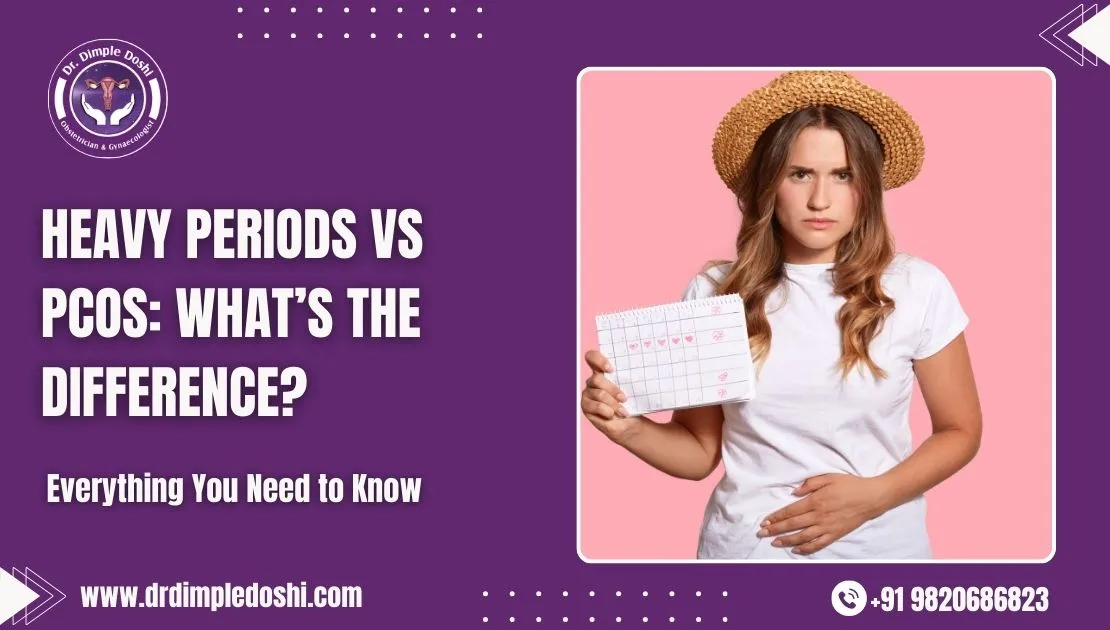
If you’re bleeding heavily every month, it’s natural to assume, “This must be PCOS.”
But heavy periods (menorrhagia / heavy menstrual bleeding) and PCOS (Polycystic Ovary Syndrome) are not the same condition. They can overlap in some women, yet the cause, pattern, and treatment approach are often different.
Let’s make it simple, clear, and clinically sensible.
Tired of heavy, exhausting periods? Get expert treatment options from Dr. Dimple Doshi.
First: What Exactly Are “Heavy Periods”?
Heavy periods mean you’re losing more blood than your body can comfortably handle—often leading to fatigue, low iron, and anemia.
Common signs of heavy menstrual bleeding
- Soaking a pad/tampon every 1–2 hours
- Clots (especially large or frequent)
- Bleeding > 7 days
- Night-time “flooding”
- Feeling weak, dizzy, breathless, or palpitations (possible anemia)
Heavy periods are a symptom, not a diagnosis. We always ask: why is it heavy?
What Is PCOS (And What It Usually Looks Like)?
PCOS is a hormonal-metabolic syndrome where the ovaries may show multiple small follicles and the body often has insulin resistance and androgen excess.
Classic PCOS pattern
- Irregular cycles (gap of 35+ days, missed periods, unpredictable bleeding)
- Infrequent ovulation (anovulation)
- Signs of androgen excess: acne, increased facial hair, hair fall
- Weight gain (not always), difficulty losing weight
- Sometimes infertility concerns
Important: PCOS is more about irregular or absent ovulation, not automatically “heavy bleeding.”
Heavy Periods vs PCOS: The Key Differences
1) Cycle pattern
- Heavy periods (non-PCOS causes): often regular monthly cycles but heavy flow
- PCOS: often delayed, irregular, infrequent periods → then a sudden heavy bleed
2) Why bleeding becomes heavy
- Heavy periods: commonly due to uterine causes (fibroids, adenomyosis, polyps), bleeding disorders, thyroid issues, or inflammation
- PCOS: heavy bleeding happens because the lining builds up for weeks/months without regular shedding → endometrium becomes thick and unstable
3) Typical accompanying symptoms
- Heavy periods (uterine cause): pelvic heaviness, painful periods, pressure symptoms, severe cramping (adenomyosis)
- PCOS: acne, hirsutism, weight/metabolic concerns, irregular cycles, infertility concerns
4) Main health risk
- Chronic heavy bleeding: iron deficiency anemia
- PCOS with prolonged gaps between periods: endometrial hyperplasia risk (especially if cycles are > 45–60 days repeatedly)
Can PCOS Cause Heavy Periods?
Yes—but usually in a specific way:
PCOS tends to cause:
- Infrequent periods
- Then when bleeding starts, it can be prolonged or heavy
Because the endometrium has been stimulated by estrogen without regular progesterone balance (anovulation).
So if you have months of no periods and then long, heavy bleeding, PCOS becomes a strong possibility—but we still rule out uterine pathology.
Then What Usually Causes Heavy Periods (If Not PCOS)?
Here are the most common causes we evaluate:
Uterine causes (very common after 30–35)
- Fibroids
- Adenomyosis
- Endometrial polyp
- Endometrial hyperplasia
Hormonal/systemic causes
- Thyroid dysfunction (hypothyroid)
- Elevated prolactin (sometimes)
- Coagulation issues (especially if heavy bleeding since teenage years)
- Medications (blood thinners)
- Perimenopause hormonal fluctuations
Bottom line: Heavy bleeding needs a structured work-up—not a guess.
How We Clinically Differentiate Them
Step 1: History (this itself gives big clues)
- Cycle length: 21–35 days regular vs long gaps?
- Duration & volume of bleeding
- Clots, flooding, anemia symptoms
- Acne/hair growth/weight changes
- Pregnancy possibility (always rule out)
- Prior ultrasound findings, fibroids, polyps
Step 2: Examination + Ultrasound (timed if possible)
- TVS to check:
- Fibroids / adenomyosis
- Polyps
- Endometrial thickness and pattern
- Ovarian morphology (PCOS-like ovaries)
Step 3: Basic labs (chosen clinically)
- CBC + ferritin (anemia + iron stores)
- TSH
- If PCOS is suspected: glucose/insulin profile, lipids, and androgen evaluation (case-based)
Step 4: When endometrial sampling is considered
If there is:
- Persistent heavy bleeding + thick endometrium
- Age 40+ with abnormal bleeding
- PCOS with prolonged irregular cycles + breakthrough heavy bleeding
- Failed medical management or recurrent bleeding
Treatment: Heavy Periods vs PCOS (Approach Is Different)
If the main issue is heavy periods
Treatment depends on cause:
- Correct anemia (iron therapy, diet, sometimes IV iron)
- Medical control of bleeding (based on suitability)
- Treat structural causes:
- Polyp removal
- Fibroid management (medical/interventional/surgical)
- Adenomyosis management
- If surgery is needed and appropriate, 3D laparoscopy (Karl Storz Rubina 4K 3D system) helps with precision, minimal blood loss, faster recovery, and cosmetically smaller scars—especially useful when anatomy is complex (fibroids/adenomyosis/adhesions).
If the main issue is PCOS
Goals are:
- Cycle regularisation (endometrial protection)
- Treat acne/hirsutism (if present)
- Improve ovulation if fertility is desired
- Address insulin resistance with lifestyle ± medication (case-based)
- Long-term metabolic health (lipids, glucose, blood pressure)
A key PCOS rule: if periods are very infrequent, we must ensure the uterine lining sheds safely and regularly.
Red Flags: Don’t Ignore These
Seek evaluation promptly if:
- Bleeding so heavy you soak pads hourly
- Clots + dizziness/fainting
- Bleeding > 10–14 days
- Post-coital bleeding
- Intermenstrual bleeding repeatedly
- Age > 40 with new-onset heavy bleeding
- Known PCOS with long gaps + very heavy prolonged bleeding
Quick Self-Check (Simple Guide)
More likely PCOS if you have:
- Periods that come late, unpredictable, or absent
- Acne/hair growth/weight-metabolic issues
- Ultrasound showing PCOS morphology + labs supporting it
More likely a uterine cause if you have:
- Regular monthly cycles but very heavy flow
- Pelvic pain/pressure
- Ultrasound shows fibroid/polyp/adenomyosis
- Worsening over time, especially after 30–35
FAQs about hevay period vs pcos
Q1. Can I have PCOS and fibroids together?
Ans. Yes. PCOS affects ovulation/hormones; fibroids are uterine muscle growths. They can coexist—and then bleeding can be even more troublesome.
Q2. Are “cysts” on ultrasound equal to PCOS?
Ans. Not always. Many normal ovaries show follicles. PCOS is diagnosed using a combination of cycle pattern + clinical features + ultrasound/labs, not ultrasound alone.
Q3. If I have PCOS, is heavy bleeding dangerous?
Ans. It can be—mainly because prolonged unopposed estrogen may increase risk of endometrial thickening/hyperplasia. That’s why cycle regulation is important.
Still have questions about heavy bleeding, periods, or anemia? Get clarity from Dr. Dimple Doshi’s expert team.
Closing Thought
Heavy periods and PCOS can look similar from the outside, but the reason behind the bleeding is what decides the right treatment. If you’re bleeding heavily, don’t self-label it as PCOS. A focused history, ultrasound, and a few labs can quickly clarify what’s going on—and help you feel in control again.