Dr. Dimple Doshi (MBBS, MD, DGO)
Gynecologist & Laparoscopic Surgeon
27+ years’ experience
20,000+ surgeries completed
Heavy periods are treatable—and most women do not need surgery. But when tests show a surgical cause (such as fibroids, adenomyosis, endometriosis, or pelvic pathology), surgery may be advised—and 3D laparoscopy allows that surgery to be done with greater precision and safety.
The Most Important Point (Please Read)
3D laparoscopy is not a default treatment for heavy periods.
In my clinical experience, surgery is recommended only when clearly needed. If medicines or non-surgical options can control bleeding and improve quality of life, we always start there.
You may have heavy menstrual bleeding if you:
Feel tired, dizzy, or breathless (often due to anemia)
Heavy periods can occur due to:
Treatment depends entirely on the underlying cause.
For many women, bleeding improves with:
If bleeding settles and quality of life improves—surgery is not needed.
Surgery may be advised when:
Only at this stage does laparoscopy come into the picture.
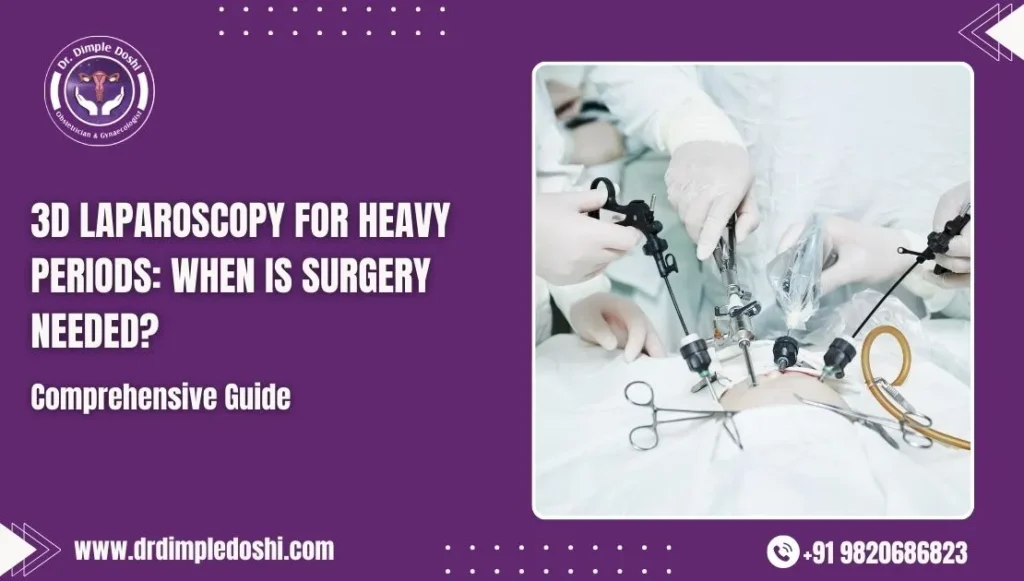
3D laparoscopy is the method used to perform surgery—more precisely.
It does not replace medicines. It is chosen only when surgery is the best option.
3D laparoscopy provides the surgeon with:
At Vardaan Hospital, we use advanced systems like the Karl Storz Rubina 4K 3D for complex gynecologic surgeries where precision truly matters.
When fibroids cause heavy bleeding and need surgery:
When disease is significant and symptoms persist:
In selected cases where conservative options fail:
3D laparoscopy supports planned surgical management.
Depending on the procedure:
Ans. No. Most women improve with medical treatment. 3D laparoscopy is used only when surgery is required.
Ans. No. It usually means the surgery is more precise, while still minimally invasive.
Ans. Usually not. I first evaluate history, examination, ultrasound, and blood tests—then recommend the safest effective option.
If heavy bleeding is affecting your daily life, don’t normalize it. Early evaluation helps identify the cause and avoid unnecessary procedures.
At Vardaan Hospital, I evaluate heavy menstrual bleeding in a structured, evidence-based manner and recommend surgery only when necessary. When surgery is indicated, I offer advanced 3D laparoscopic surgery using the Karl Storz Rubina 4K 3D system for precision and smoother recovery.
Dr. Dimple Doshi’s Tip: Heavy periods are common—but they are not something you have to silently live with. The right diagnosis leads to the right treatment, and often avoids surgery altogether.