Introduction
Many women quietly adjust to heavy periods—pushing through tiredness, dizziness, or low mood, assuming it’s normal with age or after childbirth. In my clinical experience, this delay often leads to avoidable weakness and anxiety. This guide explains why early treatment for heavy menstrual bleeding is important, safely and clearly, before it turns into an emergency.
Tired of heavy, exhausting periods? Get expert treatment options from Dr. Dimple Doshi.
What counts as “too much” menstrual bleeding?
Bleeding lasting over 7 days, soaking pads frequently, or passing large clots suggests heavy menstrual bleeding that needs evaluation.
- Bleeding > 7 days
- Passing large clots
- Needing to change pads/tampons every 1–2 hours
- Double protection (pad + tampon) still leaks
- Waking up at night to change pads
- Feeling weak, breathless, dizzy, or unusually tired during periods
Dr. Dimple Doshi’s Tip:
Heavy periods are common, but they are not normal. Your body often gives early warning signs—listening to them matters.
How does early treatment prevent iron deficiency anemia?
Treating heavy bleeding early helps preserve iron stores and prevents long-term anemia-related damage.
- Heavy bleeding gradually reduces iron stores and hemoglobin
- Many women don’t realize they are anemic until they experience:
- Fatigue and low stamina
- Palpitations, breathlessness
- Headaches, poor focus
- Hair fall, brittle nails
- Low immunity and poor sleep
- Fatigue and low stamina
Dr. Dimple Doshi’s Tip:
I often see women blame stress for these symptoms, when iron deficiency from heavy periods is the real cause.
Can early treatment reduce emergency bleeding episodes?
Yes. Early management lowers the risk of sudden, severe “flooding” bleeding that needs urgent care.
Ignored bleeding can suddenly worsen due to:
- Hormonal fluctuations
- Fibroid growth
- Endometrial instability
- Hormonal fluctuations
This may lead to:
- Sudden flooding bleeding
- Severe weakness
- Need for IV iron, blood transfusion, or urgent procedures
- Sudden flooding bleeding
Early treatment often prevents these panic situations.
Why is early diagnosis of the cause important?
Identifying the cause early allows simpler, more effective treatment.
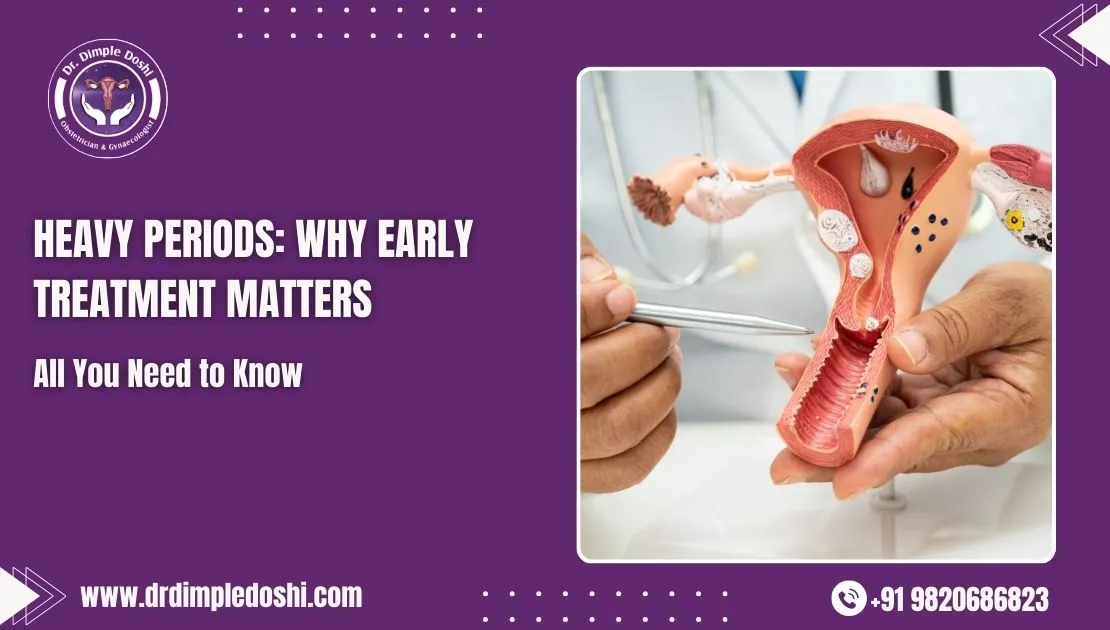
Heavy periods are commonly caused by:
- Uterine fibroids (especially submucosal)
- Endometrial polyps
- Adenomyosis
- Hormonal imbalance / anovulation
- Thyroid issues, PCOS
- Bleeding disorders (less common, but important)
- Endometrial hyperplasia (especially in women over 40 or with obesity/PCOS)
The earlier the diagnosis, the easier it is to manage—often with medicines or minimal procedures.
How does early treatment protect fertility and pregnancy plans?
Managing heavy periods early can improve uterine health and future fertility outcomes.
Early treatment may:
- Improve uterine cavity health
- Optimize ovulation and hormonal balance
- Improve implantation chances
- Reduce miscarriage risk in selected cases
Dr. Dimple Doshi’s Tip:
For women planning pregnancy, heavy periods are often a clue—not something to ignore.
Can early care help avoid surgery later?
Yes. Timely intervention may prevent disease progression and major surgery.
When heavy bleeding continues for months or years, it may lead to:
- Larger fibroids
- Worsening adenomyosis
- Thickened endometrium
Early intervention can often mean:
- Medicines first
- Hormonal support when indicated
- Small day-care procedures when needed
Minimally invasive options rather than major surgery
When should you not wait to seek help?
Certain symptoms require prompt gynecological evaluation.
- Soaking one pad every hour for several hours
- Dizziness, fainting, breathlessness
- Bleeding after sex or between periods
- Bleeding after menopause
- Severe pelvic pain with heavy flow
- Known fibroids with sudden worsening
Age over 40 with new heavy or irregular bleeding
What tests are usually done for heavy periods?
Evaluation focuses on identifying the cause and severity of bleeding.
A focused assessment typically includes:
- Detailed history (cycle pattern, clots, pain, medications)
- Clinical examination
- Pelvic ultrasound (sometimes with Doppler)
- Blood tests:
- CBC (Hb) and ferritin (iron stores)
- Thyroid profile (TSH)
- Other tests if clinically indicated (PCOS workup, coagulation profile)
- CBC (Hb) and ferritin (iron stores)
Sometimes you may need:
- Pap smear (as per age and screening)
- Endometrial sampling/biopsy (especially over 40, obesity/PCOS, persistent bleeding)
Hysteroscopy if polyp or submucosal fibroid is suspected
How does early treatment simplify management?
The earlier treatment starts, the simpler and safer it usually is.
Medical treatment options
- Tranexamic acid (during periods)
- NSAIDs (if suitable)
- Hormonal options (as per need)
- Treating thyroid or PCOS-related causes
- Iron therapy (oral or IV)
Procedures (when needed)
- Polyp removal or targeted hysteroscopic treatment
- Fibroid management (type-specific)
- Endometrial correction strategies
- Minimally invasive laparoscopic surgery when indicated
At Vardaan Hospital, Goregaon West, when surgery is required, I prefer advanced 3D laparoscopy using the Karl Storz Rubina 4K 3D system, which allows greater precision, less blood loss, smaller scars, and faster recovery.
FAQs: Early Treatment for Heavy Periods
Q1. Are heavy periods normal after 35 or after childbirth?
Ans. They are common but not normal. Evaluation is needed to rule out underlying causes.
Q2. Can heavy bleeding cause low blood pressure and weakness?
Ans. Yes. Blood loss and anemia can cause dizziness, weakness, palpitations, and fainting.
Q3. Can I still have heavy periods if my ultrasound is normal?
Ans. Yes. Hormonal causes, thyroid issues, or early adenomyosis may still be present.
Q4. When is biopsy required for heavy periods?
Ans. Often with persistent bleeding, new-onset bleeding after 40, or specific risk factors.
Q5. Can heavy periods be treated without surgery?
Ans. In many women, yes—especially when treated early.
Still have questions about heavy bleeding, periods, or anemia? Get clarity from Dr. Dimple Doshi’s expert team.
Conclusion
Heavy periods are not just “extra bleeding.” They are often your body’s early signal that something needs attention. When addressed early, treatment is simpler, recovery is faster, and emergencies are often avoided. If your periods are affecting your energy, confidence, or daily life, you deserve clarity, safety, and compassionate care—without waiting for a crisis.