
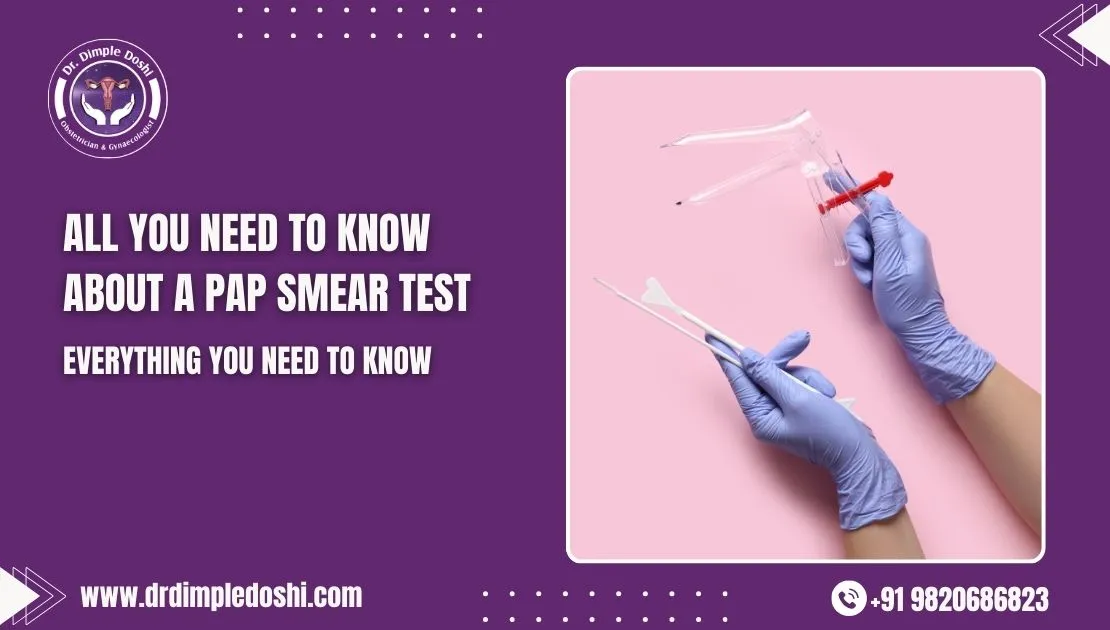
Introduction
Many women feel anxious or hesitant about gynecological tests, especially when it comes to cervical cancer screening. A Pap smear is a simple, safe, and life-saving test that helps detect cervical changes early—often before any symptoms appear. I want to help you understand this test clearly, calmly, and without fear.
What is a Pap smear test and why is it important?
A Pap smear is a cervical screening test that detects pre-cancerous and cancerous cell changes early, before symptoms develop.
The uterus has two parts:
- Body (upper part)
- Cervix (lower narrow part opening into the vagina)
A Pap smear collects cells from the cervix
These cells are examined for:
- Pre-cancerous changes
- Early cervical cancer
Early detection allows timely treatment and complete cure in most cases
Cervical cancer develops slowly, often over many years
Dr. Dimple Doshi’s Tip:
In my clinical experience, most cervical cancers are preventable with regular Pap smears and HPV screening.
Who should get a Pap smear and how often should it be done?
Pap smear frequency depends on age and risk factors, starting at 21 years and continuing till 65 years.
- Below 21 years: Pap smear not required
- Age 21–29 years: Pap smear once every 3 years
- Age 30–65 years:
– Pap smear every 3 years, or
– Pap smear + HPV test every 5 years
More frequent testing may be needed if you have:
- Previous abnormal Pap smear
- Weak immune system (chemotherapy, long-term steroids, transplant)
- HIV infection
- Multiple sexual partners
Dr. Dimple Doshi’s Tip:
Screening intervals are personalized—don’t compare your reports with others.
Who can stop Pap smear testing?
Pap smears can usually be stopped after 65 years if previous tests were normal and risk is low.
Pap smear may be stopped:
- After total hysterectomy (uterus + cervix removed for non-cancer reasons)
- Before 21 years
- After 65 years, if: Previous reports are consistently normal
Continued screening may be advised if:
- Multiple sexual partners
- High-risk factors persist
How should I prepare for a Pap smear test?
Avoid intercourse, vaginal medicines, or douching for 48 hours before a Pap smear for accurate results.
Detailed Explanation:
-
Avoid for 2 days before test:
-
Sexual intercourse
-
Vaginal creams, foams, or medicines
-
Douching
-
-
Avoid scheduling during menstruation if possible
-
No fasting or anesthesia required
How is a Pap smear test performed?
A Pap smear is a quick outpatient test done during a pelvic exam and usually takes only a few minutes.
Detailed Explanation:
-
Done in the clinic on an outpatient basis
-
No anesthesia required
-
Procedure steps:
-
You lie comfortably on an examination table
-
A speculum is gently inserted to visualize the cervix
-
Cervical cells are collected using a soft brush or spatula
-
-
Mild pressure may be felt, but it is usually painless
Dr. Dimple Doshi’s Tip:
Relaxing your pelvic muscles makes the test more comfortable—communication with your doctor helps.
Are there any risks associated with a Pap smear?
Pap smears are very safe, though rarely results may be falsely normal due to sampling limitations.
Detailed Explanation:
-
Pap smear is extremely safe
-
Rare possibility of false-negative results
-
Causes include:
-
Inadequate cell collection
-
Very few abnormal cells
-
Blood or inflammation masking abnormal cells
-
-
Cervical cancer develops slowly, so regular screening offers protection
What happens after a Pap smear test?
You can resume normal activities immediately after a Pap smear; mild spotting or cramps may occur.
Detailed Explanation:
-
No activity restrictions
-
Mild spotting or slight cramps may occur
-
Rarely, mild diarrhea due to nerve stimulation
-
Collected cells are:
-
Placed in liquid (Liquid-Based Cytology), or
-
Smeared on glass slide (Conventional method)
-
-
Samples are examined under microscope
What are the different types of Pap smear tests?
Pap smears are done as conventional smear or liquid-based cytology, with liquid-based being more accurate.
Detailed Explanation:
-
Conventional Pap Smear
-
Cells spread directly on glass slide
-
Lower accuracy due to cell loss
-
-
Liquid-Based Cytology (LBC)
-
Cells preserved in liquid medium
-
Higher accuracy
-
Allows HPV DNA testing from same sample
-
Dr. Dimple Doshi’s Tip:
At Vardaan Hospital, we prefer LBC with HPV testing for better reliability and peace of mind.
When will Pap smear results be available and what do they mean?
Pap smear results usually take 4–7 days and may be normal or abnormal, requiring further guidance.
Detailed Explanation:
-
Results usually available within 4–7 days
-
Normal (Negative) Result
-
No abnormal cells
-
Next screening as per schedule
-
-
Abnormal (Positive) Result
-
Does NOT mean cancer
-
May indicate infection, inflammation, or precancerous changes
-
-
Further tests may include:
-
Repeat Pap smear
-
HPV testing
-
Colposcopy or biopsy
-
FAQs – Common Questions Women Ask
Q1. Is Pap smear painful?
Ans. No, it is usually painless and takes only a few minutes.
Q2. Can unmarried women do a Pap smear?
Ans. Yes, if sexually active or advised by a gynecologist.
Q3. Is Pap smear required every year?
Ans. No. Most women need it every 3–5 years depending on age and results.
Q4. Can Pap smear detect infections?
Ans. Sometimes infections are seen, but its main role is cancer screening.
Q5. Is HPV testing necessary?
Ans. HPV testing improves accuracy, especially after 30 years of age.
Q6. Can cervical cancer be prevented?
Ans. Yes, with regular Pap smears, HPV testing, and vaccination.
Conclusion
Cervical cancer is one of the most preventable cancers when detected early. A Pap smear is a simple step that protects your health, fertility, and future. Regular screening, combined with HPV testing and vaccination, saves lives.
At Vardaan Hospital, Goregaon West, we offer liquid-based Pap smear and HPV DNA testing with complete privacy and care. If you have doubts or are due for screening, I encourage you to consult early—prevention truly is better than cure.