- Are your periods so heavy that you soak pads quickly, pass clots, or bleed for many days?
- Do you feel weak, anemic, or worried that something serious may be happening inside?
Heavy periods are treatable—and most women do not need surgery. But when tests show a surgical cause (such as fibroids, adenomyosis, endometriosis, or pelvic pathology), surgery may be advised—and 3D laparoscopy allows that surgery to be done with greater precision and safety.
The Most Important Point (Please Read)
3D laparoscopy is not a default treatment for heavy periods.
In my clinical experience, surgery is recommended only when clearly needed. If medicines or non-surgical options can control bleeding and improve quality of life, we always start there.
Tired of heavy, exhausting periods? Get expert treatment options from Dr. Dimple Doshi.
What Counts as Heavy Periods?
You may have heavy menstrual bleeding if you:
- Soak pads or tampons every 1–2 hours
- Pass clots frequently
- Bleed for more than 7 days
- Have night-time flooding or leakage
Feel tired, dizzy, or breathless (often due to anemia)
Why Heavy Bleeding Happens
Heavy periods can occur due to:
- Fibroids
- Adenomyosis
- Endometriosis
- Polyps
- Hormonal imbalance (PCOS/anovulation), thyroid disorders
- Less commonly, bleeding disorders or medication effects
Treatment depends entirely on the underlying cause.
Step 1: Treatment Usually Starts Without Surgery
For many women, bleeding improves with:
- Iron therapy (if anemic)
- Tranexamic acid or NSAIDs (case-dependent)
- Hormonal therapy (cyclical progesterone or combined pills)
- LNG-IUS (hormonal IUD) in suitable cases
- Treating thyroid or PCOS-related imbalance
If bleeding settles and quality of life improves—surgery is not needed.
Step 2: When Surgery Becomes Necessary
Surgery may be advised when:
- Bleeding continues despite adequate medical treatment
- Anemia keeps recurring
- Imaging confirms a structural cause needing correction
- Severe pain plus heavy bleeding suggests significant pelvic disease
- Tissue diagnosis is required
- A definitive solution is needed and family is complete (selected cases)
Only at this stage does laparoscopy come into the picture.
So, Where Does 3D Laparoscopy Help?
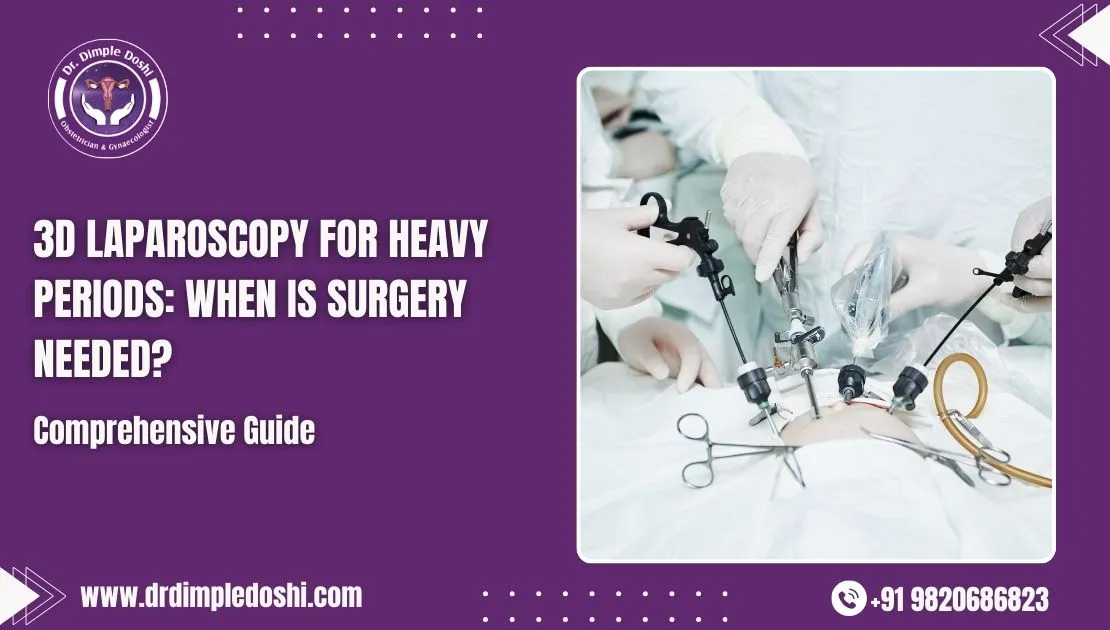
3D laparoscopy is the method used to perform surgery—more precisely.
It does not replace medicines. It is chosen only when surgery is the best option.
3D laparoscopy provides the surgeon with:
- True depth perception
- Clear identification of tissue planes
- Safer, more accurate work around the uterus, ovaries, bladder, and ureters
At Vardaan Hospital, we use advanced systems like the Karl Storz Rubina 4K 3D for complex gynecologic surgeries where precision truly matters.
Conditions Where 3D Laparoscopic Surgery Can Be Useful (If Surgery Is Indicated)
1. Fibroids
When fibroids cause heavy bleeding and need surgery:
- 3D laparoscopic myomectomy (uterus-preserving, selected cases)
- 3D laparoscopic hysterectomy (when indicated)
2. Endometriosis / Chocolate Cyst
When disease is significant and symptoms persist:
- 3D laparoscopy allows precise excision of endometriosis and ovarian cysts.
3. Adenomyosis
In selected cases where conservative options fail:
3D laparoscopy supports planned surgical management.
Benefits of 3D Laparoscopy (When Surgery Is Needed)
- Smaller cuts and minimal scarring
- Less pain and faster recovery than open surgery
- Higher precision in complex cases
- Earlier mobilization and shorter hospital stay (case-dependent)
Recovery: What Most Women Can Expect
Depending on the procedure:
- Walking the same day or next day
- Discharge often within 24–48 hours (case-dependent)
- Return to light work in 7–14 days (procedure-dependent)
FAQs Frequently Asked Question
Q1. Does every woman with heavy periods need 3D laparoscopy?
Ans. No. Most women improve with medical treatment. 3D laparoscopy is used only when surgery is required.
Q2. Does 3D laparoscopy mean the surgery is bigger?
Ans. No. It usually means the surgery is more precise, while still minimally invasive.
Q3. Will surgery be decided in the first visit?
Ans. Usually not. I first evaluate history, examination, ultrasound, and blood tests—then recommend the safest effective option.
Still have questions about heavy bleeding, periods, or anemia? Get clarity from Dr. Dimple Doshi’s expert team.
Conclusion
If heavy bleeding is affecting your daily life, don’t normalize it. Early evaluation helps identify the cause and avoid unnecessary procedures.
At Vardaan Hospital, I evaluate heavy menstrual bleeding in a structured, evidence-based manner and recommend surgery only when necessary. When surgery is indicated, I offer advanced 3D laparoscopic surgery using the Karl Storz Rubina 4K 3D system for precision and smoother recovery.
Dr. Dimple Doshi’s Tip: Heavy periods are common—but they are not something you have to silently live with. The right diagnosis leads to the right treatment, and often avoids surgery altogether.